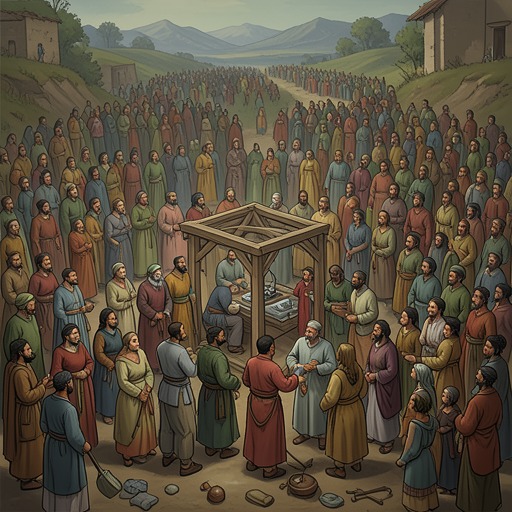
Philip meets and baptizes the Ethiopian eunuch
Acts of the ApostlesPhilip meets and baptizes the Ethiopian eunuch on the wilderness road from Jerusalem to Gaza, a decisive movement in Acts’ account of witness outward from Jerusalem. The encounter carries the message of the Realm beyond Samaria across geographic, ethnic, political, and gendered boundaries. In the book’s interpretation, baptism does more than mark an individual conversion: it assures the eunuch that his life is not defined by the powers that have limited him and gives him a place in a community awaiting restoration.
Setting and Participants
The encounter follows the witness in Samaria and takes place beyond Jerusalem, on the wilderness road toward Gaza. An angel directs Philip to a chariot, and the Spirit guides the meeting. The chariot signals that its passenger is well supplied and holds high office; the eunuch is treasurer to the Candace, a title for the queen of Ethiopia. His political standing and his position as a person whose gender and reproductive status shaped his social experience make this meeting an expansion of the story’s reach in more than one sense.
The eunuch is reading Isaiah when Philip encounters him. Literacy was uncommon in antiquity, making his reading a notable detail as well as the starting point for their exchange. He is described as likely a God-fearer: a gentile drawn to Judaism without becoming a full convert. He had traveled to Jerusalem to worship, yet Leviticus and Deuteronomy set limits on eunuchs’ participation in Temple worship. The account therefore brings together religious attraction, proximity to worship, and a constraint on full participation without reducing ancient Jewish attitudes toward eunuchs to a simple story of uniform exclusion.
Scripture and the Encounter
The passage identifies the eunuch’s reading as Isaiah 53:7–8. Its servant is compared to a sheep led to slaughter, remains silent, and is denied justice; the passage ends with the servant’s life taken from the earth. In Isaiah’s original setting, the servant is the community of Israel, and the passage speaks from the experience of exile. Readers familiar with the wider context of Isaiah would recognize a people derided after defeat and displacement, whose continued trust in God becomes a witness to other nations and whose return vindicates that trust.
This scriptural background makes the meeting more than a private reading lesson. The eunuch’s passage opens onto Israel’s story of suffering and witness, while Acts presents the encounter as part of the movement of that witness toward the ends of the earth. The interpretation does not erase the passage’s history or make Israel’s experience incidental: Israel’s witness to the nations supplies the scriptural frame through which the scene’s expanding community can be understood.
Baptism and Belonging
The eunuch wants to be baptized. In Luke’s end-time theology, baptism signifies forgiveness of sins, understood not only as release from personal transgression but also as release from the ultimate domination of the powers of the old age. It also marks entry into the community of the Realm. For the eunuch, baptism therefore carries a direct assurance: the forces that have broken or limited him do not determine the ultimate meaning of his life, and he has a place in the community moving toward final restoration.
The book draws a further implication from the eunuch’s circumstances. Because he is cut off from the children and continuation of a family line valued in antiquity, the community of the Realm can, in a certain sense, become his sons and daughters. The interpretation links this belonging to the coming age, in which sexuality no longer has its present role. It presents communal membership not as a denial of the eunuch’s history but as a promise that his future and significance exceed the limits imposed by that history.
Water also gives the baptism a particular resonance in the setting. In antiquity it was associated with life, fertility, and generativity; those associations were especially strong in semi-arid places such as a wilderness road. The book reads baptism here as a return of generativity: an assurance that those who identify with the eunuch are not ultimately cut off or rendered unfruitful. Since baptism creates community, that promise also places responsibility on the church to become a generative community, encouraging life and possibility among its members and in the wider world.
Narrative and Theological Significance
The episode represents both a geographical turn and a widening of the church’s mission. Earlier Easter readings in the lectionary take place in Jerusalem; this story is the first to occur outside the city, on the way toward the ends of the earth. The movement recalls Acts’ larger witness mission and challenges a congregation to remain open to encounters that may disrupt the comfort of familiar communal boundaries. The book describes solidarity with others as a blessing not only to those newly included but also to the community whose understanding of the Realm is enlarged through the encounter.
The eunuch’s inclusion should not be used to flatten the complexity of Judaism or to claim that Judaism simply excluded him while the church simply welcomed him. The book warns that such a contrast can reinforce anti-Jewish attitudes and obscure the church’s own ambiguity and failures toward people represented by the eunuch. The episode’s challenge is consequently twofold: to recognize the Realm’s widening invitation and to examine whether the church itself lives up to the welcome and solidarity it proclaims.
The lectionary appoints Acts 8:26–40 for the Fifth Sunday of Easter in Year B. Because the passage directly quotes Isaiah 53:7–8 and presumes Isaiah 56:1–8, the book recommends reading those prophetic texts alongside it. That pairing keeps the encounter grounded in Israel’s Scriptures while making visible the narrative’s outward movement: the church is guided from the familiar setting of Jerusalem onto a wilderness road, where an unexpected participant helps disclose the breadth of the community being formed.